Why Most Marketing Plans Are Wrong.


Not slightly wrong. Fundamentally wrong.
Because they ignore the most powerful force in marketing.
Word of mouth.
WOM is, was, and always will be the greatest form of marketing.
And yet…
In 40 years in business, I’ve never seen a marketing plan that even mentions WOM.
Never mind one designed primarily to drive it. (Insane.)
Because every legendary product, category, and movement grows the same way:
People tell other people.
Not ads.
Not funnels.
Not “content calendars.”
People.
Talking.
To people.
So for the launch of Creator Capitalist, we decided to do something different.
We built the Founding 50.
These are our Superconsumers who volunteered to watch (and help) us launch the book in public.
Specifically:
• watch us run the lightning strike
• watch us learn LinkedIn marketing in real time
• watch whether two old dogs could learn new tricks
And the objective of this whole experiment is simple:
Maximize WOM.
But here’s the funny part.
We quickly realized the obvious LinkedIn metrics are terrible at measuring WOM.
Views don’t measure WOM.
Likes don’t measure WOM.
Comments barely measure WOM.
So last week we realized something important:
We needed new metrics.
And this week we realized we needed a new way to categorize posts to find them.
We started sorting everything into four buckets:
• Relational — personal stories
• Social Proof — look at outcomes
• Curiosity — weird data and observations
• Frameworks — lenses that explain the past and predict the future
And something jumped off the page.
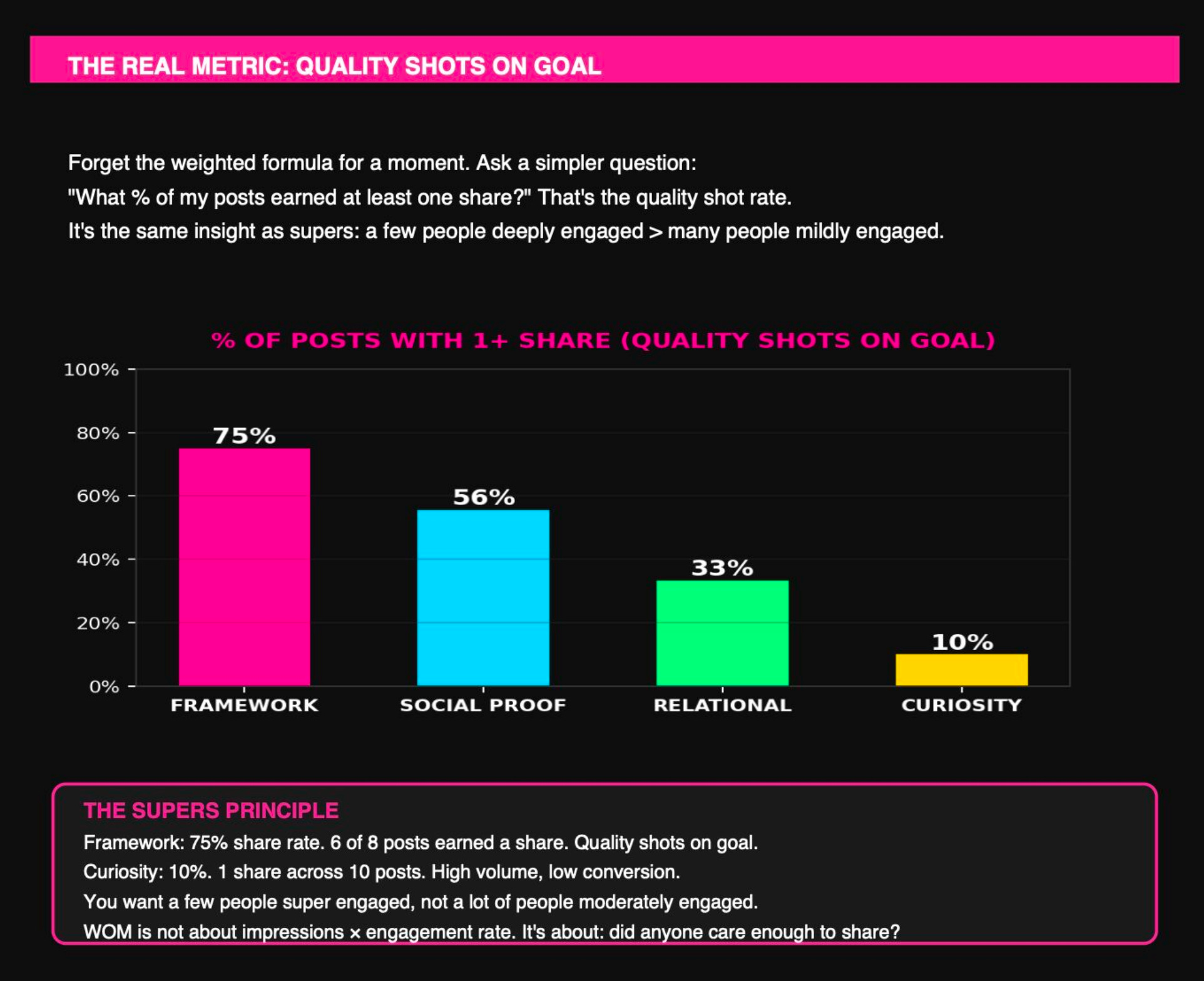
Framework posts crush everything else.
Which led to an important insight:
Sometimes data about the data matters more than the data itself.
Here’s what the early signals are telling us.
Shares are by far the best proxy for WOM
The category of post matters more than the post itself
More framework posts → more shares → more shots on goal at WOM
So the obvious next move?
Reverse engineer the ideal framework post.
Here’s the five-step formula you can steal.
1. Reject the premise
The hotter the take (that you can back up), the better.
2. Show specific data
Real numbers. Real companies. Real outcomes.
3. Explain the past and predict the future
If your framework can’t do both, it’s weak.
4. Give a practical playbook
Three clear things people can do right now.
5. Make it travel
It has to be broadly useful so people want to share it.
We know this works.
Because these five steps are derived from the same formula we (we being mostly Eddie Yoon) used writing 60+ Harvard Business Review articles.
And guess what those posts did?
They traveled.
Which is another way of saying: They created WOM.
Inside Creator Capitalist, we’re sharing everything with the Founding 50:
• the data
• the charts
• the formulas
• and the mistakes
Because if you want your ideas to spread, WOM can’t be accidental.
It has to be designed.
And the uncomfortable truth for most marketers is this:
They don’t design WOM.
They design content.
Huge difference.
🏴☠️
Creator Capitalist launches March 17, 2026.
Don’t miss out.